
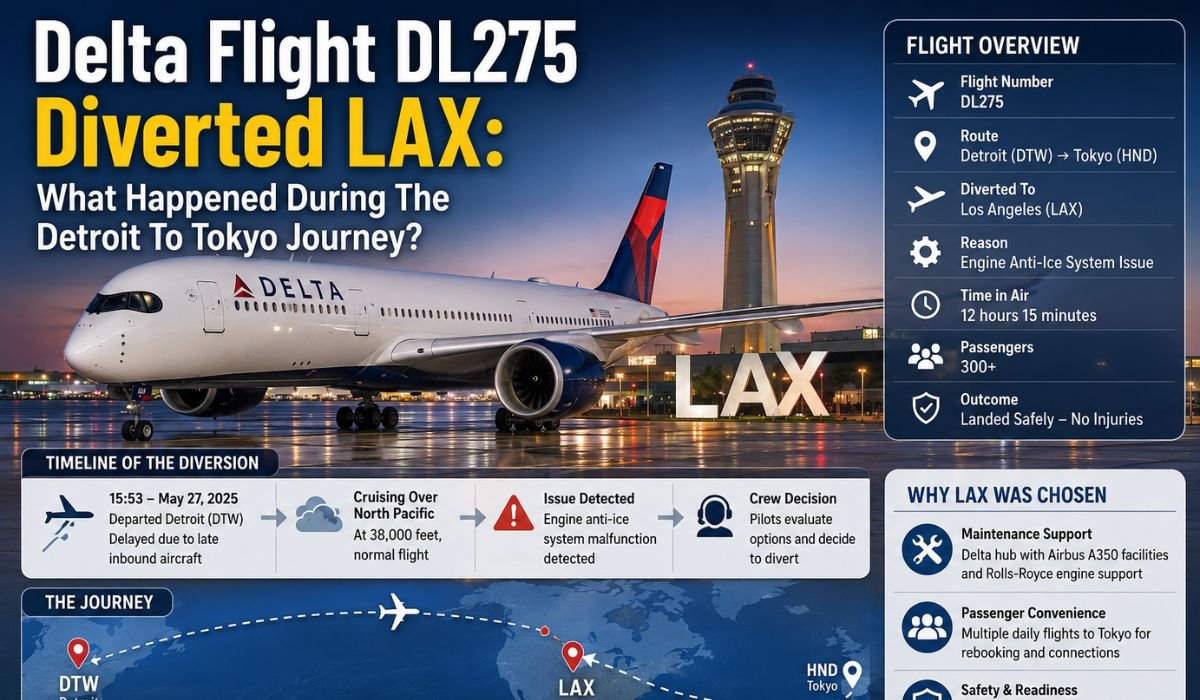
When news broke that Delta Flight DL275 Diverted LAX, travelers and aviation enthusiasts immediately wanted answers. A routine long-haul journey from Detroit to Tokyo suddenly became an unexpected aviation story that highlighted the importance of aircraft safety, pilot decision-making, and modern airline operations.
While flight diversions are not uncommon in commercial aviation, every diversion has its own unique circumstances. In this case, Delta Flight DL275, operating between Detroit Metropolitan Wayne County Airport and Tokyo Haneda Airport, changed course and landed safely at Los Angeles International Airport after a technical concern was identified during the flight.
The incident attracted attention because it involved one of the world’s most advanced passenger aircraft, the Airbus A350-900. It also sparked discussions about aircraft maintenance, engine systems, passenger safety, and the growing role of predictive technology in aviation.
This detailed guide explores everything known about the event, explains why the diversion occurred, examines how airlines handle situations like this, and looks at what travelers can learn from the experience.
Quick Bio Information
| Information | Details |
|---|---|
| Flight Number | DL275 |
| Airline | Delta Air Lines |
| Departure Airport | Detroit Metropolitan Wayne County Airport |
| Destination Airport | Tokyo Haneda Airport |
| Diversion Airport | Los Angeles International Airport |
| Aircraft Model | Airbus A350-900 |
| Aircraft Registration | N508DN |
| Engine Type | Rolls-Royce Trent XWB |
| Original Route | Detroit To Tokyo |
| Diversion Reason | Reported Engine Anti-Ice System Issue |
| Flight Type | International Long-Haul |
| Landing Outcome | Safe Landing At LAX |
| Passenger Injuries | None Reported |
| Crew Response | Followed Safety Procedures |
| Aircraft Manufacturer | Airbus |
| Engine Manufacturer | Rolls-Royce |
| Airport Code Departure | DTW |
| Airport Code Destination | HND |
| Airport Code Diversion | LAX |
| Industry Focus | Aviation Safety And Maintenance |
What Happened To Delta Flight DL275?
The story of Delta Flight DL275 Diverted LAX began as a normal international flight. Passengers boarded an Airbus A350-900 in Detroit and prepared for a lengthy journey across the Pacific Ocean to Tokyo. Such routes are operated daily by major airlines and are considered routine within modern aviation.
For several hours, the flight progressed normally. The aircraft climbed to its cruising altitude and followed its planned route over North America and toward the Pacific. At some point during the journey, however, the flight crew reportedly identified a problem involving an engine anti-ice system.
Whenever a technical issue affects a critical aircraft system, pilots must carefully assess the situation. They work with airline operations teams, maintenance experts, and air traffic control to determine the safest course of action. In this case, the decision was made to divert the flight rather than continue all the way to Japan.
Although diversions can be inconvenient for passengers, they are a clear example of aviation’s safety-first philosophy. The goal is always to reduce risk and ensure that every flight reaches a suitable airport where maintenance and support resources are available.
Delta Flight DL275 Timeline
Understanding the timeline helps explain why the diversion became a significant aviation event. According to reports, the flight departed Detroit after experiencing an earlier delay related to aircraft scheduling. Once airborne, the aircraft settled into what appeared to be a standard transpacific journey.
As the aircraft continued westward, flight crews monitored hundreds of systems through advanced cockpit displays. Modern aircraft continuously provide data regarding engines, navigation systems, environmental controls, and other critical components.
During the flight, indications reportedly suggested a malfunction involving an engine anti-ice system. The aircraft itself remained fully controllable, but the crew needed to consider the implications of continuing a long journey across the Pacific Ocean.
After evaluating available options, the flight crew selected Los Angeles International Airport as the most suitable diversion point. The aircraft eventually arrived safely at LAX, where maintenance teams and operational support staff were available to assist both passengers and the aircraft.
The successful diversion demonstrated the effectiveness of modern aviation procedures. Every step, from identifying the issue to selecting a diversion airport, followed established safety protocols designed to protect passengers and crew.
Why Was Delta Flight DL275 Diverted To LAX?
The primary reason reported for the diversion was an issue involving the aircraft’s engine anti-ice system. While this may sound minor to many travelers, anti-ice systems play an important role in aircraft operations, especially during high-altitude flight.
Commercial aircraft often encounter atmospheric conditions where ice can form on critical surfaces or engine components. Anti-ice systems help prevent dangerous ice accumulation that could affect performance or reliability.
If an anti-ice system does not function as expected, pilots must evaluate whether continuing the flight remains appropriate. Airlines and regulators generally favor conservative decision-making in these situations. Rather than waiting for a problem to become more serious, crews often divert to a suitable airport where inspections and repairs can be performed.
The decision involving Delta Flight DL275 Diverted LAX reflects this approach. Safety margins are intentionally high in commercial aviation, and even relatively small technical concerns can justify a diversion when operating on long international routes.
For passengers, this may seem frustrating. However, aviation professionals often view such decisions as evidence that safety systems are working exactly as intended.
What Is An Aircraft Engine Anti-Ice System?
Many readers may wonder why an anti-ice system is important enough to alter an international flight. The answer lies in the environment where commercial aircraft operate.
At cruising altitudes, temperatures can drop far below freezing. Moisture present in clouds and surrounding air can freeze upon contact with aircraft surfaces or engine components. Left unchecked, ice buildup can interfere with airflow and reduce efficiency.
Aircraft manufacturers therefore design specialized systems that use heat or other technologies to prevent ice formation. These systems are particularly important for engines because consistent airflow is essential for safe operation.
The Rolls-Royce Trent XWB engines used on the Airbus A350 are highly sophisticated powerplants. They incorporate multiple monitoring systems and protective technologies to maintain reliable performance across a wide range of operating conditions.
If cockpit indications suggest that an anti-ice system is not functioning correctly, pilots must take the issue seriously. Even if the aircraft remains safe to fly, the safest option may be to land at an airport where engineers can conduct a detailed inspection.
This is one reason aviation remains one of the safest forms of transportation in the world. Airlines do not wait for small problems to become large ones.
Why Los Angeles International Airport Was Chosen
One of the most interesting aspects of the event is why Los Angeles was selected instead of another airport. The answer involves several operational and logistical considerations.
Los Angeles International Airport is one of the largest aviation hubs in the world. It offers extensive maintenance facilities, experienced technical personnel, and infrastructure capable of supporting widebody aircraft like the Airbus A350.
Because Delta maintains significant operations at LAX, the airline also has access to customer service teams, replacement crews, passenger accommodations, and alternative flight options. This makes it easier to assist travelers whose journeys are interrupted.
Another important factor is runway capability. Long-haul aircraft can carry substantial fuel loads, and airports selected for diversions must be capable of safely accommodating these aircraft under various conditions. LAX provides long runways, advanced emergency services, and favorable operational resources.
The choice of Los Angeles demonstrates how diversion decisions are rarely based on a single factor. Pilots and airline operations centers evaluate maintenance capabilities, passenger needs, weather conditions, airport facilities, and overall safety before making a final decision.
Meet The Airbus A350-900
The aircraft involved in the incident was an Airbus A350-900, one of the most advanced commercial airliners currently in service. Introduced as a next-generation long-haul aircraft, the A350 was designed to improve fuel efficiency, passenger comfort, and operational reliability.
The aircraft features advanced composite materials, modern flight systems, and highly efficient engines. Airlines around the world use the A350 on routes connecting major international destinations across continents.
Passengers often appreciate the aircraft’s quieter cabin, improved air quality, larger windows, and enhanced comfort during long flights. For airlines, the A350 offers lower fuel consumption and impressive range capabilities.
Importantly, the diversion involving Delta Flight DL275 should not be interpreted as a reflection of the aircraft’s overall safety. Modern commercial aircraft are designed with multiple layers of redundancy, and diversions are part of the industry’s normal safety framework.
The fact that the flight landed safely and that established procedures worked as intended actually demonstrates the strength of modern aviation systems rather than a failure of them.
How Flight Diversions Work In Commercial Aviation
When travelers hear that a flight has diverted, they often assume an emergency is taking place. In reality, diversions are a normal part of airline safety procedures. Commercial aviation is built around preparation, risk management, and redundancy. Pilots are trained to evaluate situations long before they become emergencies.
For a flight such as Delta Flight DL275, operating across the Pacific Ocean, crews constantly monitor aircraft systems and weather conditions. If a technical issue appears that could affect the remainder of the journey, pilots work with airline operations centers and maintenance specialists to determine the safest solution. This process involves analyzing airport options, available maintenance resources, fuel requirements, weather conditions, and passenger considerations.
The diversion to Los Angeles demonstrates how the aviation industry prioritizes caution. Rather than continuing thousands of miles across the ocean with a reported system concern, the crew selected an airport capable of supporting both the aircraft and its passengers. Such decisions are one reason commercial aviation continues to maintain an outstanding safety record worldwide.
How The Diversion Affected Passengers
For passengers aboard the flight, the diversion likely transformed what should have been a straightforward international journey into an unexpected travel challenge. Long-haul travelers often have connecting flights, hotel reservations, business meetings, family commitments, and other plans waiting at their destination.
When Delta Flight DL275 landed in Los Angeles instead of Tokyo, airline teams would have begun coordinating passenger assistance. This typically includes rebooking travelers on alternative flights, arranging overnight accommodations when necessary, and providing updates regarding revised schedules. Airlines understand that communication becomes especially important during disruptions.
Many passengers reportedly appreciated the professionalism shown by the flight crew. Calm communication from pilots and flight attendants can significantly reduce anxiety during an unexpected diversion. Even though travel plans may have changed, the successful landing and organized response helped ensure that passengers remained safe throughout the event.
The experience also serves as a reminder that delays and diversions, while inconvenient, are usually made in the interest of passenger safety rather than operational convenience.
The Importance Of Pilot Decision-Making
One of the most impressive aspects of modern aviation is the level of training pilots receive before commanding international flights. Airline captains and first officers undergo extensive preparation involving aircraft systems, emergency procedures, weather management, and risk assessment.
In the case of Delta Flight DL275 Diverted LAX, the flight crew had to evaluate technical information, consider the aircraft’s location, review airport options, and make a decision that balanced operational efficiency with passenger safety. Such choices often must be made quickly while maintaining complete situational awareness.
Modern cockpit technology provides valuable data, but human judgment remains essential. Pilots are trained not only to operate aircraft but also to make informed decisions under pressure. The successful diversion highlights the effectiveness of that training and demonstrates why professional flight crews remain one of aviation’s most important safety assets.
Behind every safe diversion is a combination of experience, teamwork, and adherence to established procedures.
Understanding ETOPS And Long-Haul Flight Safety
Because Delta Flight DL275 was traveling between North America and Asia, it operated under rules commonly known as ETOPS, which stands for Extended Twin-Engine Operations. These regulations allow twin-engine aircraft to fly long distances from diversion airports while maintaining strict safety standards.
The Airbus A350 is certified for extensive ETOPS operations, making it ideal for transpacific routes. Airlines planning these flights carefully evaluate diversion airports along the route before departure. This ensures that crews always have suitable alternatives available if weather, technical issues, or medical emergencies arise.
The existence of ETOPS planning means that diversions are not improvised decisions. Airports, routes, fuel calculations, and contingency plans are considered long before a flight leaves the gate. When a technical concern emerged aboard DL275, the crew could rely on these pre-established planning procedures.
For passengers, this system provides reassurance that even during unexpected situations, airlines have multiple layers of preparation designed to maintain safety.
Could Technology Help Prevent Similar Incidents?
The incident also sparked discussions about the future of aircraft maintenance. Modern airlines increasingly rely on sophisticated monitoring systems that collect and analyze enormous amounts of operational data from aircraft components.
Advanced sensors can track engine performance, temperatures, pressures, vibration levels, and system status throughout every flight. This information allows maintenance teams to identify trends that might indicate developing issues before they become operational concerns.
Some aviation experts believe predictive maintenance technology could eventually reduce the number of diversions caused by technical issues. By detecting unusual patterns early, airlines may be able to inspect or replace components before problems appear during flight.
While no technology can eliminate every mechanical issue, the industry continues to invest heavily in systems that improve reliability and reduce unexpected disruptions. The discussion surrounding Delta Flight DL275 has become part of a larger conversation about how data-driven maintenance could shape the future of air travel.
The Growing Role Of Artificial Intelligence In Aviation
Artificial intelligence is increasingly becoming a valuable tool within the aviation industry. Airlines, aircraft manufacturers, and maintenance providers are exploring ways to use AI to improve safety, efficiency, and operational decision-making.
AI systems can process large amounts of aircraft data much faster than traditional methods. By identifying patterns that humans might overlook, these systems can help maintenance teams prioritize inspections and address potential issues earlier.
In addition to maintenance, AI is being used for route optimization, fuel planning, weather analysis, and operational forecasting. These technologies help airlines operate more efficiently while maintaining high safety standards.
However, experts emphasize that AI is designed to support human professionals rather than replace them. Engineers, pilots, and maintenance specialists still play the primary role in interpreting information and making final decisions. The future of aviation will likely combine advanced technology with human expertise to create even safer operations.
The Financial Impact Of A Flight Diversion
Although passenger safety remains the top priority, diversions can be expensive for airlines. A long-haul international flight involves significant operational costs even under normal circumstances. When a diversion occurs, additional expenses quickly accumulate.
These costs can include fuel consumption, maintenance inspections, passenger accommodations, crew scheduling adjustments, aircraft repositioning, and compensation for disrupted travel plans. Airlines may also face logistical challenges as they work to restore normal schedules.
Reports associated with Delta Flight DL275 referenced a multimillion-dollar cost estimate, although such figures should generally be viewed as estimates unless officially confirmed by the airline. The actual financial impact of any diversion depends on numerous operational factors.
Despite these costs, airlines consistently prioritize safety over economics. The aviation industry’s culture emphasizes that protecting passengers and crew always comes first.
What Aviation Experts Can Learn From Delta Flight DL275
Every significant aviation event provides opportunities for learning and improvement. Even when a flight lands safely and procedures function exactly as intended, industry professionals carefully analyze what occurred.
Maintenance teams review technical data, engineers examine affected systems, and airline safety departments assess operational decisions. These reviews help identify improvements that may reduce future risks or enhance response procedures.
The Delta Flight DL275 diversion highlights the value of proactive decision-making. It demonstrates how pilots, maintenance teams, and airline operations centers work together to address concerns before they escalate into more serious situations.
Such events also reinforce the importance of continuous investment in training, technology, and maintenance programs. Aviation remains one of the safest industries in the world because it constantly learns from every operational experience.
Why The Airbus A350 Remains Highly Trusted
Whenever a flight diversion receives media attention, some travelers wonder whether the aircraft involved has safety concerns. In the case of Delta Flight DL275, it is important to understand that a diversion does not indicate a problem with the overall aircraft design.
The Airbus A350 has established a strong reputation among airlines and passengers since entering service. It operates thousands of flights annually across major international routes and is widely recognized for its efficiency, comfort, and reliability.
Modern commercial aircraft are designed with multiple backup systems and extensive monitoring capabilities. In many cases, diversions occur specifically because these systems successfully identify a concern before it develops further.
The safe outcome of the DL275 incident actually reflects the effectiveness of modern aircraft engineering, pilot training, and airline safety procedures.
The Bigger Picture For Airline Safety
The story of Delta Flight DL275 Diverted LAX is ultimately a story about aviation safety working as intended. Although passengers experienced an unexpected disruption, the flight crew identified a concern, followed established procedures, and landed safely at an airport equipped to provide support.
Events like this remind travelers that commercial aviation is built on layers of protection. Aircraft are carefully maintained, pilots undergo extensive training, and airlines continuously invest in technology that improves safety and reliability.
While diversions often generate headlines, they are usually examples of successful risk management rather than failures. The fact that the aircraft landed safely, passengers remained unharmed, and operations were handled professionally demonstrates the strength of modern aviation systems.
Final Thoughts
The incident involving Delta Flight DL275 attracted widespread attention because it combined a long-haul international route, a modern Airbus A350, and an unexpected diversion to Los Angeles. While the reported engine anti-ice system issue disrupted travel plans, the event ultimately showcased the aviation industry’s commitment to safety.
From the flight crew’s decision-making to the availability of maintenance resources at LAX, every aspect of the response reflected established procedures designed to protect passengers. The diversion also highlighted broader conversations about predictive maintenance, artificial intelligence, and the future of aircraft reliability.
For travelers, the key takeaway is reassuring. The reason commercial aviation remains remarkably safe is that airlines and pilots are willing to act cautiously whenever concerns arise. Delta Flight DL275 Diverted LAX may have interrupted a journey from Detroit to Tokyo, but it also demonstrated how modern aviation systems work together to ensure safe outcomes.
FAQs About Delta Flight DL275 Diverted LAX
Was Delta Flight DL275 An Emergency Flight?
The flight was diverted as a precautionary safety measure after a reported technical issue involving the engine anti-ice system. While the situation required attention, the aircraft remained under control and landed safely at Los Angeles International Airport.
Why Did Delta Flight DL275 Divert To LAX Instead Of Continuing To Tokyo?
Los Angeles offered extensive maintenance resources, airline support services, suitable runway infrastructure, and alternative travel options for passengers. These factors made it an appropriate diversion airport.
Were Any Passengers Injured During The Diversion?
No injuries were reported. The aircraft landed safely, and passengers were assisted by airline personnel after arrival at LAX.
What Aircraft Was Operating Delta Flight DL275?
The flight was operated by an Airbus A350-900, a modern long-haul aircraft powered by Rolls-Royce Trent XWB engines.
What Is An Engine Anti-Ice System?
An engine anti-ice system helps prevent ice buildup on critical engine components during flight. These systems are important for maintaining reliable engine performance in cold atmospheric conditions.
How Long Was Delta Flight DL275 In The Air Before Diverting?
Reports indicate that the aircraft spent more than twelve hours in the air before landing safely at Los Angeles International Airport.
Could Predictive Maintenance Have Prevented The Diversion?
Some aviation experts believe advanced monitoring and predictive maintenance technologies may help identify certain developing issues before departure. However, no system can guarantee the prevention of every technical problem.
Is The Airbus A350 A Safe Aircraft?
Yes. The Airbus A350 is considered one of the safest and most advanced commercial aircraft operating today. It is widely used by major airlines on long-haul international routes around the world.
Recommended For You: Michael Tell: The Untold Story of Patty Duke’s Brief Husband and Sean Astin’s Biological Father
