
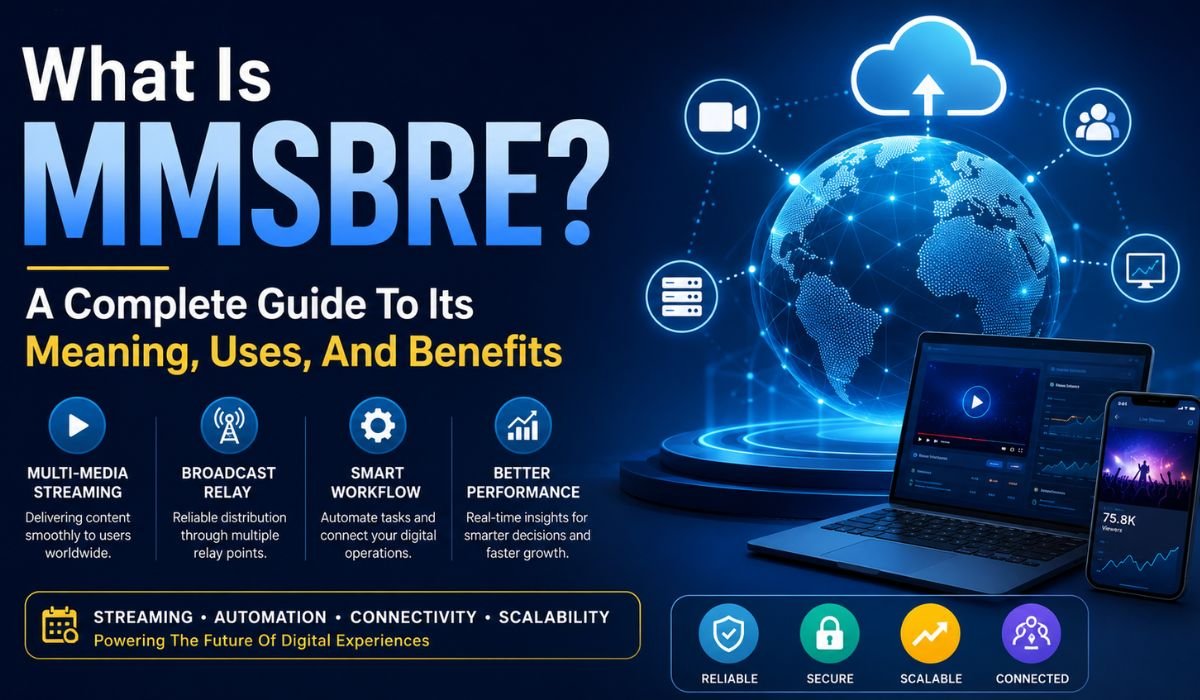
If you have recently searched for MMSBRE, you are not alone. Over the past year, the term has started appearing in search results, technical discussions, website addresses, and online conversations. While it may seem like a complicated technology at first glance, many people simply want to know one thing: What is MMSBRE, and why is it being discussed so much?
The challenge is that there is very little beginner-friendly information available. Most online explanations either assume readers already understand networking and streaming technology or present MMSBRE as if everyone already knows what it means. In reality, many readers are discovering the term for the first time and want a clear explanation without confusing technical language.
In this guide, you will learn what MMSBRE means, how it relates to digital media, streaming, workflow automation, and connected business systems, and why it has become an increasingly searched topic in 2026. You will also discover the technologies commonly associated with the concept, its practical applications, its benefits, and its limitations. Whether you are a content creator, business owner, IT professional, or simply curious about digital infrastructure, this guide will help you understand the bigger picture.
What Is MMSBRE?
The term MMSBRE is commonly expanded as Multi-Media Streaming And Broadcast Relay Environment. It describes the idea of building connected digital systems that move information, media, and workflows efficiently between different services and users.
Unlike a traditional software application that performs one specific task, MMSBRE is better understood as a conceptual architecture or design approach. It focuses on creating an environment where streaming services, communication tools, cloud platforms, automation systems, and analytics work together instead of operating separately.
It is also important to understand that MMSBRE is not currently recognized as an official industry standard in the same way as technologies like HTTP, WebRTC, or MPEG-DASH. Instead, the term is used in some online discussions and documentation to describe integrated digital environments that combine streaming infrastructure with connected workflows.
At its heart, MMSBRE represents three simple ideas.
First, digital systems should communicate with each other automatically.
Second, media and information should move reliably and efficiently.
Third, organizations should reduce repetitive manual work through better integration and automation.
These ideas have become increasingly important as businesses rely on cloud software, remote collaboration, live streaming, and digital services every day.
What Does MMSBRE Stand For?
Understanding each part of the acronym makes the overall concept much easier to understand.
Multi-Media refers to different forms of digital content, including video, audio, images, presentations, documents, and interactive media. Modern organizations rarely work with just one type of content. Instead, they constantly create and share multiple forms of media across different platforms.
Streaming describes the process of delivering audio or video continuously over the internet rather than requiring users to download an entire file first. Streaming powers everything from live sports and webinars to online education and entertainment services.
Broadcast refers to distributing content to many viewers at the same time. A live product launch watched by thousands of people is one example of digital broadcasting.
Relay is one of the most important concepts. Instead of sending information directly from one source to every viewer, relay servers receive content and pass it along to other servers or users. This approach improves reliability, reduces network congestion, and allows large audiences to receive content smoothly.
Finally, Environment describes the complete ecosystem where all these technologies work together. Instead of focusing on one tool, the environment includes hardware, software, cloud services, security systems, automation, monitoring, and communication between connected platforms.
When combined, these words describe a digital ecosystem designed to move media and information efficiently while supporting modern online operations.
Why Is Everyone Talking About MMSBRE?
One reason MMSBRE has attracted attention is that people are becoming more interested in the technology that powers the digital services they use every day. Businesses now depend heavily on cloud software, live communication platforms, and connected applications. As a result, curiosity about the underlying infrastructure has naturally increased.
Another reason is the growing visibility of technical terminology. People sometimes encounter “MMSBRE” within URLs, software documentation, testing environments, or developer resources. Even if they never interact directly with the technology, seeing an unfamiliar term often encourages them to search for its meaning.
The rapid growth of the creator economy has also contributed to this trend. Independent creators now operate businesses that depend on live streaming, online collaboration, digital marketing, and automated workflows. As creators expand their operations, they naturally become more interested in the systems that help deliver reliable content to audiences around the world.
At the same time, businesses of every size are searching for better ways to connect their digital tools. Instead of managing isolated software applications, organizations increasingly want integrated systems where customer information, marketing platforms, analytics, project management, and communication tools work together automatically. Concepts associated with MMSBRE align closely with these goals, making the topic more relevant than ever.
How Does MMSBRE Work?
Although implementations can vary, the overall process follows a logical sequence that is easy to understand.
Everything begins with a source. This source could be a live camera, a webinar platform, an online meeting, a business application, or even a content management system.
The source generates information that needs to reach one or more destinations. Rather than sending everything directly to every user, the information often passes through intermediary systems that organize, process, monitor, and distribute the data more efficiently.
In streaming environments, relay servers receive the original video or audio feed before forwarding it to viewers through multiple network locations. This reduces the workload on the original server and improves reliability during periods of heavy traffic.
In business environments, the same idea applies to information rather than media. Customer records, project updates, marketing data, and financial information can automatically move between connected software platforms through application programming interfaces, commonly known as APIs.
Modern cloud infrastructure adds another layer by providing scalable computing resources that expand automatically as demand increases. Analytics platforms continuously monitor performance, while security systems verify user permissions and protect sensitive information throughout the process.
Instead of functioning as isolated pieces, every component communicates continuously, creating an efficient digital environment capable of supporting thousands—or even millions—of simultaneous interactions.
Key Components Of An MMSBRE Environment
Although every implementation is different, several technologies frequently appear in environments associated with MMSBRE principles.
The first component is the media or data source. This is where information originates, whether it is a live video stream, uploaded media file, customer database, or internal business application.
The second component is the processing layer. Here, information may be encoded, compressed, analyzed, or prepared before distribution. For streaming services, this often includes converting video into multiple quality levels so viewers with different internet speeds receive the best possible experience.
Next comes the relay infrastructure. Relay servers help distribute information across multiple network locations instead of relying on a single central server. This greatly improves scalability and reduces the likelihood of service interruptions during periods of heavy demand.
Another essential element is cloud computing. Cloud platforms provide flexible computing power, storage, and networking resources that organizations can scale as needed without investing heavily in physical infrastructure.
Application Programming Interfaces, or APIs, serve as communication bridges between different software platforms. APIs allow systems that were built independently to exchange information automatically without requiring manual data entry.
Modern environments also depend on monitoring and analytics platforms. These systems continuously collect performance metrics, identify potential issues, measure user activity, and help administrators optimize overall performance.
Security remains equally important. Encryption, authentication, access control, and compliance measures protect both media content and sensitive business information from unauthorized access.
Together, these technologies create an environment that is reliable, scalable, and capable of supporting modern digital operations.
Common Uses Of MMSBRE
Although the exact term MMSBRE is not universally adopted across the technology industry, the principles associated with it are already used in many real-world situations.
One of the most familiar examples is live streaming. Online events, conferences, gaming broadcasts, educational courses, and entertainment platforms all depend on reliable media delivery systems that can serve large audiences simultaneously. Relay infrastructure, adaptive streaming, and cloud scalability work together to maintain consistent viewing experiences.
Businesses also apply similar principles to improve internal operations. Rather than requiring employees to manually transfer information between multiple software applications, connected systems automatically synchronize customer records, project updates, invoices, inventory data, and communication tools. This saves time while reducing the risk of human error.
Educational institutions increasingly rely on integrated digital environments as well. Online classrooms combine live video, learning management systems, file sharing, messaging platforms, assessments, and analytics into unified experiences that support both instructors and students.
Healthcare organizations use connected systems to manage appointments, secure communications, patient records, and telemedicine services while maintaining strict privacy requirements. Financial institutions similarly depend on integrated platforms that process transactions securely across multiple systems in real time.
Content creators also benefit from these ideas. A growing YouTube channel or podcast business often depends on scheduling tools, cloud storage, analytics dashboards, audience engagement platforms, and marketing automation working together smoothly. Instead of managing each platform separately, creators can connect them to streamline daily operations and focus more on producing valuable content.
As digital transformation continues across industries, the principles commonly associated with MMSBRE are becoming increasingly relevant to organizations seeking more efficient, connected, and scalable ways of working.
Main Benefits Of MMSBRE
One of the biggest strengths associated with MMSBRE is its ability to bring different digital systems together. In many organizations, information is scattered across multiple platforms. Sales teams may use one application, marketing departments another, and finance teams a completely different system. When these platforms communicate automatically, employees spend less time transferring information manually and more time focusing on meaningful work.
Another important benefit is improved reliability. In streaming environments, relay servers and cloud infrastructure help distribute network traffic efficiently. If one server experiences heavy demand or an unexpected problem, traffic can often be redirected to another available server. This reduces interruptions and creates a smoother experience for viewers.
Scalability is another advantage. Modern cloud platforms allow businesses to increase computing resources when demand grows and reduce them when traffic declines. This flexibility helps organizations manage costs while maintaining good performance during busy periods.
Better decision-making also becomes possible because connected systems generate real-time information. Managers can monitor project progress, system performance, customer activity, and operational efficiency through centralized dashboards instead of collecting reports from multiple departments.
Automation offers additional value by reducing repetitive tasks. Routine processes such as updating customer records, sending notifications, creating invoices, or assigning new projects can happen automatically through integrated workflows. Over time, these improvements save significant amounts of time while reducing human error.
Challenges And Limitations Of MMSBRE
Although the ideas behind MMSBRE are valuable, implementing connected digital environments is not always simple. Every organization has different software, workflows, security requirements, and technical capabilities. Integrating all of these systems often requires careful planning.
One common challenge is compatibility. Older software applications may not support modern APIs or cloud integrations. In these situations, organizations may need custom development work or gradual system upgrades before full automation becomes possible.
Security also deserves careful attention. Connecting multiple platforms increases the importance of strong authentication, encryption, user permissions, and continuous monitoring. Organizations must ensure sensitive information remains protected as data moves between systems.
Cost can be another consideration. While cloud services often reduce long-term infrastructure expenses, initial implementation, employee training, and system integration may require meaningful investment. Small businesses should evaluate their priorities carefully before expanding into more advanced digital environments.
Finally, technology alone cannot solve inefficient business processes. Before introducing automation, organizations should first understand how their workflows operate today. Automating poorly designed processes simply allows mistakes to happen more quickly. Successful implementation always begins with improving the underlying workflow.
MMSBRE Vs Traditional Digital Systems
Traditional digital systems often operate independently. One department manages customer information, another handles projects, while accounting maintains financial records elsewhere. Employees frequently copy information between systems manually, increasing the chance of delays and mistakes.
An environment based on MMSBRE principles aims to remove these barriers. Instead of isolated software applications, connected systems exchange information automatically whenever appropriate.
This difference becomes especially valuable during fast-moving projects. Customer information updates immediately across connected platforms. Project milestones trigger notifications automatically. Reports generate from live data instead of outdated spreadsheets. Team members spend less time searching for information because it already exists where they need it.
Another major distinction involves visibility. Traditional systems often rely on historical reports that summarize completed work. Connected environments provide continuous monitoring, allowing managers to identify issues while projects are still in progress. Earlier visibility often leads to faster decisions and better outcomes.
Although both approaches can support business operations, integrated systems generally provide greater efficiency, better collaboration, and more accurate information for organizations managing complex digital workflows.
Technologies Commonly Associated With MMSBRE
Several well-established technologies support the concepts commonly connected with MMSBRE.
Cloud Computing provides flexible infrastructure that allows organizations to increase or decrease computing resources according to demand. Instead of maintaining expensive physical servers, businesses can use scalable cloud services.
Content Delivery Networks, often called CDNs, distribute static content such as images, videos, and website files through servers located around the world. Although a CDN is not the same as a relay environment, both technologies improve content delivery and user experience.
Adaptive Bitrate Streaming automatically adjusts video quality according to each viewer’s internet connection. Instead of constant buffering, viewers receive the highest quality their connection can support at that moment.
Load Balancing distributes incoming traffic across multiple servers, preventing individual systems from becoming overloaded during busy periods.
Failover Systems improve reliability by automatically switching to backup resources if primary systems experience problems.
Application Programming Interfaces (APIs) allow independent software applications to exchange information automatically, making workflow automation possible.
Finally, Artificial Intelligence and Machine Learning are increasingly used to analyze performance, predict system behavior, identify unusual activity, and recommend workflow improvements. These technologies are becoming important additions to modern digital operations.
How Businesses And Content Creators Can Apply MMSBRE Principles
The ideas behind MMSBRE are valuable for organizations of every size, not only large enterprises.
Small businesses can begin by identifying repetitive manual tasks. If employees regularly copy information between software applications, simple automation may eliminate unnecessary work while improving accuracy.
Content creators can benefit by connecting scheduling platforms, cloud storage, analytics dashboards, email marketing services, and social media management tools. These connections reduce administrative work and allow creators to spend more time producing valuable content.
Marketing agencies often integrate customer relationship management software with project management tools and reporting platforms. This creates smoother collaboration while giving clients more accurate performance information.
Educational organizations can connect learning platforms, communication systems, digital libraries, and assessment tools to create better online learning experiences.
Large enterprises may implement more advanced architectures that combine cloud infrastructure, security monitoring, workflow automation, streaming services, and enterprise analytics into highly integrated digital environments.
Regardless of organization size, the most successful approach is gradual improvement. Starting with one or two useful integrations allows teams to learn the technology before expanding into more complex automation.
Common Misconceptions About MMSBRE
Because information about MMSBRE is still relatively limited, several misunderstandings have appeared online.
One common misconception is that MMSBRE is a specific software product. In reality, the term is generally used to describe a broader concept involving connected digital infrastructure rather than one commercial application.
Another misconception is that it only relates to live streaming. While streaming technology is an important part of the discussion, many descriptions also associate MMSBRE with workflow automation, cloud computing, business integration, and digital operations.
Some readers also assume every organization requires an advanced implementation. In practice, businesses should adopt only the technologies that genuinely improve their operations. A small company may need only a few simple integrations, while a global enterprise requires far more sophisticated infrastructure.
Understanding these distinctions helps readers approach the topic with realistic expectations rather than viewing MMSBRE as a single solution for every technological challenge.
The Future Of MMSBRE
Digital infrastructure continues to evolve rapidly, and many of the ideas connected with MMSBRE are becoming increasingly important.
Artificial intelligence is expected to automate more operational decisions, helping organizations detect problems earlier, optimize workflows, and improve system performance without constant manual intervention.
Cloud-native applications will continue replacing older software that depends on local servers. This transition makes it easier for organizations to build flexible digital environments that support remote work and global collaboration.
Streaming technology is also improving. Lower latency, higher video quality, stronger network optimization, and more efficient compression techniques continue enhancing online experiences for businesses, educators, entertainment providers, and independent creators.
At the same time, cybersecurity will remain a major priority. As organizations connect more systems together, protecting sensitive information through encryption, identity management, and continuous monitoring becomes increasingly essential.
Whether or not the term MMSBRE becomes more widely adopted, the principles behind connected, scalable, and automated digital systems are likely to shape technology for many years.
Tips For Getting Started With MMSBRE Concepts
Organizations interested in applying these ideas should begin by reviewing their current digital environment. Identify every software platform used regularly and examine where information must still be transferred manually.
The next step is prioritization. Rather than connecting every application immediately, focus first on one workflow that consumes significant time or frequently causes errors. Even a single successful automation can provide measurable improvements.
Businesses should also document workflows before introducing automation. Understanding existing processes makes future improvements easier while reducing implementation risks.
Regular performance monitoring is equally important. Analytics help determine whether automation actually saves time, improves accuracy, or increases productivity.
Finally, remember that technology works best when employees understand how and why systems operate. Ongoing training helps teams adapt confidently while encouraging continuous improvement as organizational needs evolve.
Conclusion
MMSBRE represents a modern way of thinking about digital infrastructure. Rather than viewing streaming platforms, cloud services, analytics, automation, and business software as separate technologies, it encourages building connected environments where information flows smoothly between systems.
Although the term itself is not yet an established industry standard, the concepts associated with it reflect many of the technologies shaping digital transformation in 2026. Organizations increasingly depend on integrated workflows, scalable cloud infrastructure, reliable media delivery, and intelligent automation to remain efficient and competitive.
Whether you manage a growing business, create online content, or simply want to understand emerging technology trends, learning the principles behind MMSBRE provides valuable insight into how today’s digital systems work together. By focusing on better integration, thoughtful automation, and continuous improvement, organizations of every size can build smarter, more reliable, and more efficient digital environments for the future.
FAQs About MMSBRE
What Is MMSBRE?
MMSBRE commonly stands for Multi-Media Streaming And Broadcast Relay Environment. It generally refers to the idea of building connected digital environments that combine streaming infrastructure, automation, cloud services, and integrated business workflows.
Is MMSBRE An Official Technology Standard?
There is currently no widely recognized international technology standard officially named MMSBRE. The term is generally used as a descriptive concept rather than a formal technical specification.
How Does MMSBRE Improve Digital Operations?
By connecting software platforms through automation and shared infrastructure, MMSBRE-style environments reduce manual work, improve collaboration, increase reliability, and provide better visibility into daily operations.
Is MMSBRE Only Used For Streaming?
No. Although streaming is one important application, the broader concept also includes workflow automation, cloud infrastructure, business integration, monitoring systems, and digital collaboration.
Can Small Businesses Benefit From MMSBRE Principles?
Yes. Small organizations often gain significant value by automating repetitive tasks, connecting commonly used software, and improving communication between digital tools without implementing highly complex enterprise systems.
What Technologies Are Related To MMSBRE?
Common technologies include Cloud Computing, APIs, Content Delivery Networks, Relay Servers, Adaptive Bitrate Streaming, Load Balancing, Workflow Automation, Artificial Intelligence, and Real-Time Analytics.
Will MMSBRE Become More Important In The Future?
The underlying ideas of connected systems, automation, cloud infrastructure, and intelligent digital operations are becoming increasingly important. Regardless of how widely the term itself is adopted, these principles are expected to play a growing role in modern technology.
Recommended For You: Elizabeth Anderson Martin Biography: Everything To Know About William Shatner’s Ex-Wife
